


ANNA KARENINA
This performance is conceived as a journey of the soul.
It explores the inner movement of the human being - the growth, the falling, the awareness, and the consequences of every choice we make. At its core, the performance questions what the soul learns through life: how it evolves, how it fails, and how both right and wrong decisions shape its destiny. Every action carries weight, not only in society but, most importantly, within the soul itself.
The story is told through Anna’s perspective, as a return to memory. The stage becomes a space of recollection, where fragments of her past arrive like train wagons - each one carrying a moment, a choice, a mistake. Through this continuous flow, Anna relives her life, searching for the point where her soul began to fall, where she lost awareness, and why she was unable to grow despite having the chance.
The train is a central visual and symbolic element - not only as a motif of fate, but as a mechanical force representing society. It is ever-present, moving, unstoppable. Within it, a chorus of masked figures embodies the social structure that surrounds and suffocates the individual. These figures gradually close the space around Anna, forming a living wall that restricts her movement and ultimately traps her. While Vronsky can pass through this structure, Anna cannot - revealing the imbalance of power, freedom, and consequence.
The scenographic and physical language is built on the principle of contraction. As the performance progresses, the space becomes smaller, tighter, more suffocating. Parallel to this, the physical relationship between Anna and Vronsky transforms - from attraction and closeness into tension, distance, and finally complete disconnection. Their love, initially driven by instinct and passion, reveals itself as unstable and unsustainable, lacking deeper connection and shared values.
In contrast, Levin stands as a counterpoint - a parallel journey of the soul. While Anna’s path leads toward fragmentation and collapse, Levin’s develops toward awareness, responsibility, and genuine love, which he finds with Kitty. Through this duality, the performance creates a clear contrast between destruction and growth, illusion and truth.
The visual world blends the organic and the mechanical: the living body, breath, rhythm, and instinct stand against rigid structures, repetition, and control. Elements such as movement, sound, and symbolic objects are used not as decoration, but as extensions of the characters’ inner states.
Ultimately, this is a performance about awareness - about the necessity to turn inward in a world that constantly pulls us outward. It reflects on a society that often forgets the soul, prioritizing appearance, status, and external validation, while neglecting inner truth.
“Anna Karenina” here becomes not only a story of love and tragedy, but a meditation on responsibility, consciousness, and the irreversible path of the human soul.


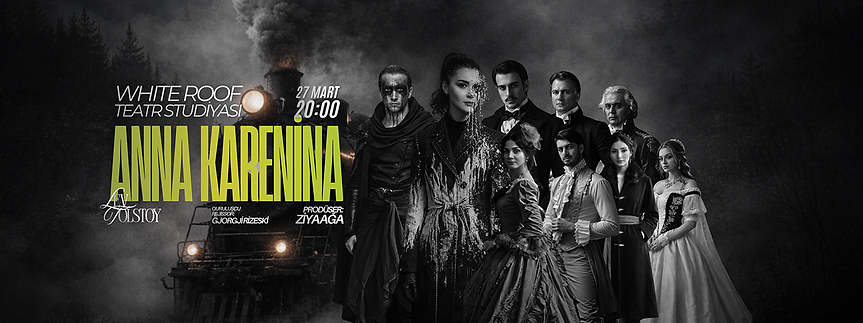


Theatre : White Roof Theatre Studio
Author : Leo Tolstoy
Executive Producer : Ziya Ağa
Director : Gjorgji Rizeski
Project Manager : Firudin İbrahimbəyli
Composer : Almir Bajramsky
Stage Designer : Vusal Rahim
Costumer : Gunay Azmemmedova
Ballet Master : Anar Mikayilov
Props : Hatire Husein Alyieva
Translation : Ziya Ağa
Proofreader : Vidadi Həsənov
Make Up Artist : Nura Babayeva
Light Designer : Vadim Fikrət
Sound Designer : Ravan Hasanzade
Video : Fahir Samadoglu
Photography : Rufat Fatali
Anna : Oksana Rasulova
Levin : Firdovsi Atakişiyev
Vronsky : Senan Kazimoff
Karenin : Ilqar Cahangir
Stiva : Tural Rza
Dolly : Aydan Aghazadeh
Kitty : Pervin Dadasheva
Princess Betsy : Sabina Asim
Seriozha : Nihat Esgerov
Countess Vronsky : Sabina Asim
Figure : Nicat Memmedov
Society 1 : Afgan Sultanov
Society 2 : Fagan Aliyev
Society 3 : Madina Agayeva
Society 4 : Sonel Seferova
Society 5 : Aysel Cabbarli
Society 6 : Ibrahim Cabiyev
Society 7 : Ismail Imamverdiyev
Society 8 : Karolina Alsanli
Society 9 : Mahabbet Ocaqverdiyeva
Society 10 : Sahib Ahmedov
Society 11 : Serxan Hesenaliyev
Film Crew : Fahir Semedoghlu . Efgan Elesov
Kamil Eliyev . Nijat Jebrayilov
Pr Manager : Gulnare Allahverdiyeva
Translator : Aysel Jabbarli
Stage Technologist : Isa Asadov
Stage Engineers : Zeynal Rahimov
Javad Hesenov . Yusif Kazimzade
Decorators : Bakhtiyar Guliyev
Qasim Seferov . Hesenov Hesen
Bakhish Mirzelyev . Valeh Abdullayev
Usubeli Eyyubov
Assistants of MUA : Zehra Gasimova
Nermin Abdullayeva
2026