


GODOT
Somewhere in the near future, the world no longer resembles the world that humanity once knew. The boundaries between man and machine have gradually disappeared, and civilization, exhausted by pain, wars, fears, diseases, and loneliness, has begun to create a new order – an order in which emotions are weakness, memories are a burden, and the soul is an obstacle to perfection. People no longer seek truth, but stability. They no longer seek love, but security. They no longer seek freedom, but a system that will think instead of them. Thus began the process of the silent disappearance of man.
The machines did not come through violence. They did not come to destroy humanity. They came as help. As salvation. As a promise of a better life. Slowly they entered everyday life, into the body, into thought, into memory. Man voluntarily began to replace his own nature with something more efficient, calmer, and more controllable. Pain began to be cured. Fear to be regulated. Loneliness to be simulated. And the soul – to be forgotten.
At the center of this new world there is a system. A vast mechanism that observes, analyzes, and transforms. A system that creates a new man. Not a man who feels, but a man who functions. The space in which Vladimir and Estragon find themselves is part of that process. A laboratory. A waiting room. A prison. An experiment. A place where time no longer has meaning. The days repeat themselves. The conditions change. Reality is programmed. Someone watches them. Someone tests them. Someone decides how long the day will last, when night will fall, when the wind will blow, when the moon will appear. Their lives have been turned into a simulation.
Above them, the Boy stands constantly. Quiet. Calm. Watching.
And so they wait. They wait for salvation. They wait for meaning. They wait for someone to tell them that suffering has an end. They wait for something that will justify their pain. But in a world where man is gradually disappearing, perhaps the most terrifying question is not who Godot is—but what you must become in order to finally see him.


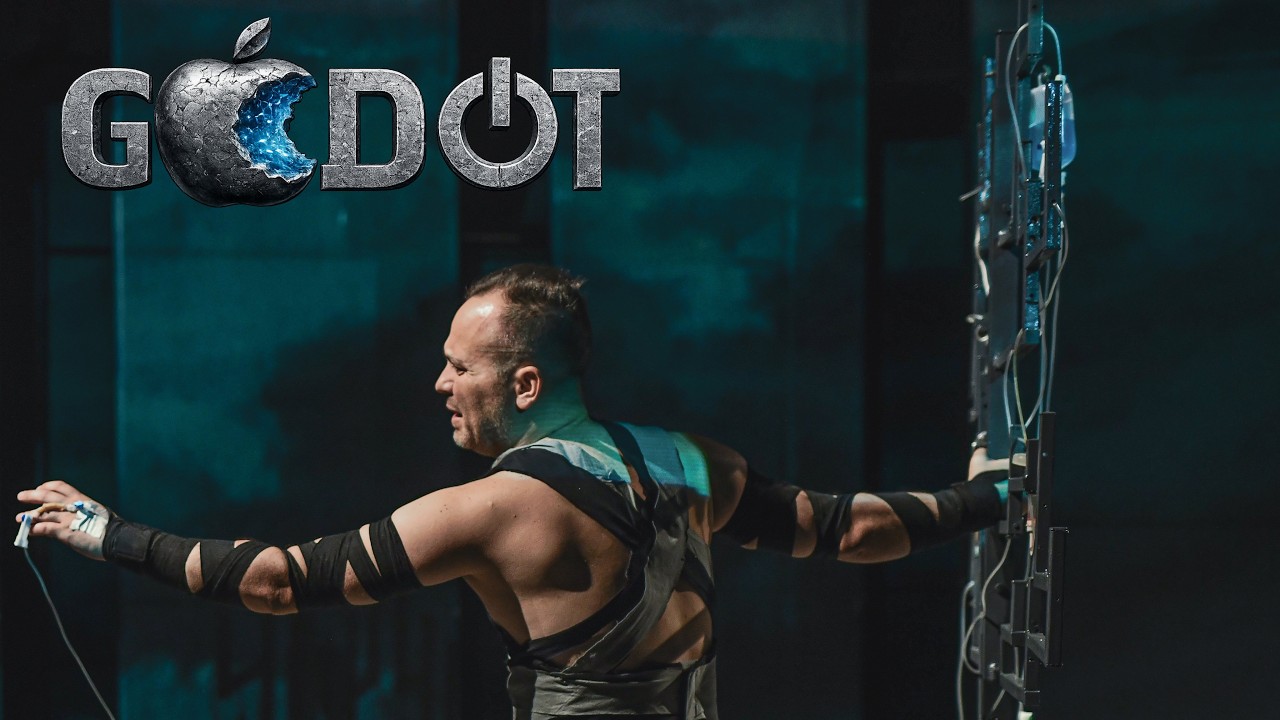


Theatre: National Theatre Jordan Hadzi Konstantinov Dzinot Veles
National Theatre Kumanovo . National Theatre Shtip . Edu Info Media
Author: Samuel Beckett
Director: Gjorgji Rizeski
Idea and Adaptation: Gjorgji Rizeski . Eftim Trajchov Gjaurski
Producer: Eftim Trajchov Gjaurski . Zharko Spasovski
Set Designer: Filip Korunovski
Costume Designer: Monika Gacheva
Composer: Sashko Kostov
Choreographer: Sanja Ruseska
Animator: Filip Korunovski
Make-up: Andrijana Andreeva
Photographs: Krste Shupev
Photography and Video Design: Aleksandar Vrzhalski
Poster Design: Aleksandar Arsov
Vladimir: Eftim Trajchov Gjaurski
Estragon: Marko Trajković
Pozzo: Zharko Spasovski
Lucky: Marija Bresliska
The Boy: Joana Panzova
General Director: Zharko Spasovski
Joana Sarafimovska . Pece Ristevski
Technical Manager: Nikola Ignov
Stage Manager: Slavisha Georgiev
Lighting Technician: Marjan Todorovski . Zoran Jordev
Sound Technician: Sashko Kostov
Video Operator: Filip Korunovski
Tailor: Panche Stojmenov
Prompter: Orhideja Dukova
Wardrobe: Elena Kochanovska
Props: Blagoj Iliev . Sashka Danailovska
Set Decorators: Igor Gavrilov . Hisham Latifov
Gjore Pavlov . Jovica Stamenkovski . Trajche Kulev
Roberto Karadakovski . Nikola Spasev . Aleksandar Kostov
Igor Stojiljković . Leonid Nikolov
Special Thanks To: Municipality of Shtip . Shtip Cultural Summer
Telekabel . Longurov Print Studio
2026